
Silver vs white fillings: which is right for your tooth?
Most people now choose tooth-coloured fillings, but many adults still have older silver ones. Here is how they compare and when replacing them makes sense.
For rebuilding a chipped front edge rather than filling a cavity, see composite bonding.
Two materials, one job
A filling seals a tooth after decay has been removed, restoring its shape and stopping bacteria getting back in. For decades the standard material was silver amalgam. Today most dentists, including our team in Al Majaz, use tooth-coloured composite, commonly called white fillings.
Patients often ask whether white fillings are as strong as silver, whether old silver fillings are safe and whether they should replace them. This guide answers those questions honestly, so you can make a calm, informed choice.
White fillings vs silver at a glance
Appearance
Composite fillings match the tooth colour. Silver fillings are grey and can darken the tooth around them.
Tooth removal
Composite fillings bond to the tooth, so less healthy tooth needs to be removed.
Strength
Modern composite is strong enough for most back teeth. Very large fillings may be better as crowns.
Lifespan
Both can last many years. Silver fillings may last longer in very large cavities; composite is easier to repair.
Placement
Composite fillings need a dry field and more time to place carefully in layers.
Temperature
Composite conducts heat less than metal, which some patients find more comfortable.


How white fillings work
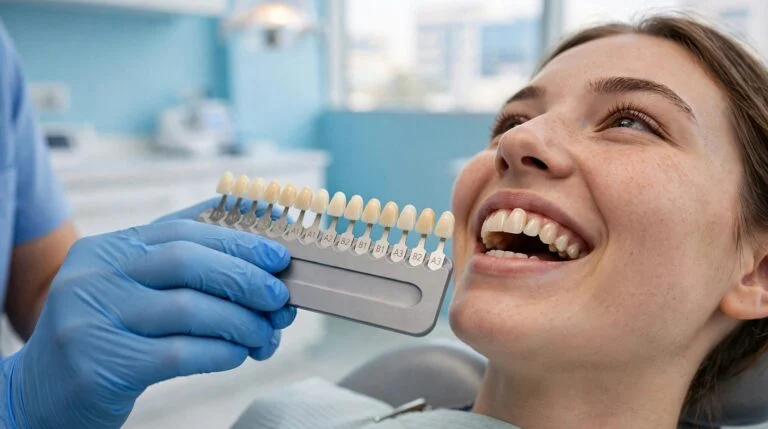
Composite is a resin mixed with very fine glass or ceramic particles. After the decay is removed, the tooth is treated with a bonding agent, and the composite is placed in thin layers. Each layer is hardened in seconds with a blue curing light. The final layer is shaped to match the natural grooves of the tooth and polished.
Because composite fillings bond to the enamel and dentine, they can support the remaining tooth structure and seal the edges well. That is one reason dentists can keep cavities smaller and more conservative with composite than with silver.
How silver fillings work
Silver amalgam is a mixture of metals including silver, tin and copper, combined with mercury to form a hard, durable material. It doesn’t bond to the tooth, so the cavity has to be shaped with undercuts to hold the filling in place. That usually means removing more healthy tooth than a white filling would need.
Amalgam is robust and tolerant of moisture, which is why it was used for so long. Many people still have amalgam fillings that have lasted decades.
Are silver fillings safe?
This is the most common question we hear. Major health organisations consider amalgam fillings safe for most people, and intact fillings do not need to be removed for health reasons. Some countries now limit amalgam use for pregnant women, young children and people with specific conditions, mainly as a precaution and for environmental reasons. Removing sound fillings unnecessarily can weaken the tooth.
Our approach
- We don’t remove sound fillings without a reason
- We replace fillings that are cracked, leaking or decayed underneath
- We use composite fillings for new cavities
- We explain the options before any replacement
Not sure what you need?
Get a free check-up and X-ray. A dentist explains your options and gives you the cost in writing. Open until 10 PM on Al Khan Street, Al Majaz.
When to replace old silver fillings
Replace a silver filling when it’s cracked or broken, when there is decay underneath or at the edges, when the tooth around it has cracks, or when you would simply like a more natural look and the tooth is suitable. An X-ray helps us see problems that are invisible from the outside. Replacing a large old filling may sometimes reveal that a crown is the better long-term option.
Replacing a silver filling with white fillings
Check and X-ray
We examine the filling and take an X-ray. The consultation and X-ray are free.
Numbing and isolation
The tooth is numbed and kept dry, which is important for bonding.
Removing the old filling
The amalgam is removed carefully with suction, along with any decay.
Bonding and layering
Composite is placed in layers and cured, then shaped and polished.
How long do white fillings last?
Well-placed composite fillings commonly last many years. Their lifespan depends on the size of the filling, how well you clean, your diet and whether you grind your teeth. Small fillings in teeth that are cleaned well often last a very long time. When a white filling does wear or chip, it can often be repaired by adding fresh composite rather than replacing the whole thing, which is a real advantage over silver.
White fillings for back teeth
Patients sometimes worry that composite fillings are only for front teeth. Modern composites are designed for chewing forces and are routinely used in molars. For very large cavities, where most of the tooth is missing, an onlay or crown may protect the tooth better than any direct filling, white or silver. We’ll tell you which is most appropriate.
Cost and insurance
Composite fillings take a little longer to place because each layer is bonded and cured separately, but they are now the standard filling in most clinics. Most UAE plans with dental cover include fillings as basic treatment. Our guide to tooth filling cost in Sharjah explains the factors that affect the price, and our insurance page lists accepted networks.
Caring for fillings of any kind
Fillings don’t decay, but the tooth around them can. Brush twice a day with fluoride toothpaste, clean between your teeth daily, cut down on sugary snacks and drinks between meals and keep up regular check-ups. If you grind, a night guard protects fillings from cracking. For general background, the NHS guide to healthy teeth and gums is a good reference, and our tooth filling page explains our approach.
Sensitivity after a new filling
It’s common for a tooth to feel a little sensitive to cold or biting for a few days after any filling, especially a deep one. This usually settles on its own. If the bite feels high, come back so we can adjust it; a high spot can cause soreness. Pain that’s severe, throbbing or lasts more than a couple of weeks should be checked, as the nerve may need attention.
Why white fillings are now the default
The shift to composite fillings happened for several reasons: patients want natural-looking teeth, bonding allows smaller and more conservative cavities, and materials have improved greatly in strength and wear resistance. Environmental concerns about mercury have also encouraged many countries to phase down amalgam. For most new cavities, composite fillings are simply the better fit for modern dentistry.
Allergies and sensitivities
Allergies to filling materials are rare. A small number of people react to components of amalgam or to some resins. If you have a known allergy, tell us before treatment so we can choose a suitable material. Most people have no problems with either type.
Combining treatment
If you have several old silver fillings that need replacing, we usually prioritise teeth with problems first and plan others over time. This spreads the cost and lets you see how you feel about composite fillings before committing to more. There is no need to replace everything at once.
What to expect on the day
Most patients are surprised how quick and comfortable the process is. You can return to work afterwards, eat once the numbness wears off, and the tooth looks natural immediately. If you’re nervous, tell us; we’ll explain every step and you can raise a hand to pause at any time.
Children and white fillings
For children, composite fillings are usually the first choice because they are conservative and look natural. Keeping the tooth dry can be a challenge with young children, so we work quickly and gently. Preventing cavities with fluoride, sealants and good brushing habits is always better than any filling.
White fillings questions
Are white fillings as strong as silver?
Should I replace my silver fillings?
Do white fillings stain?
How long do white fillings take?
Are white fillings covered by insurance?
Thinking about your old fillings?
Book a free consultation and X-ray in Al Majaz. We’ll check your fillings and tell you honestly whether anything needs replacing.
Written by our dentists
Written by the dental team at Al Jazeera Dental Clinic, a family clinic on Al Khan Street, Al Majaz 3, Sharjah, open since 1998, and medically reviewed by Dr Ranjeet Kumar, Medical Director (BDS, Diploma in Endodontics), November 2026 (how we write and review).
Related articles
Crown vs Filling: Which Does Your Tooth Need?
Crown or filling? How much healthy tooth is left decides. When a filling is enough, when a crown protects the tooth, after root canal, cost and ins…
Aligners vs Braces: Which Is Right for You?
Aligners vs braces compared by a Sharjah dental team: looks, comfort, results, speed, cost, cleaning and who each suits. Free orthodontic assessmen…
Root Canal vs Extraction: Which Is Better for You?
Root canal vs extraction: comfort, cost over time, success rates, recovery and what replacing a tooth involves. An honest guide to saving or removi…