
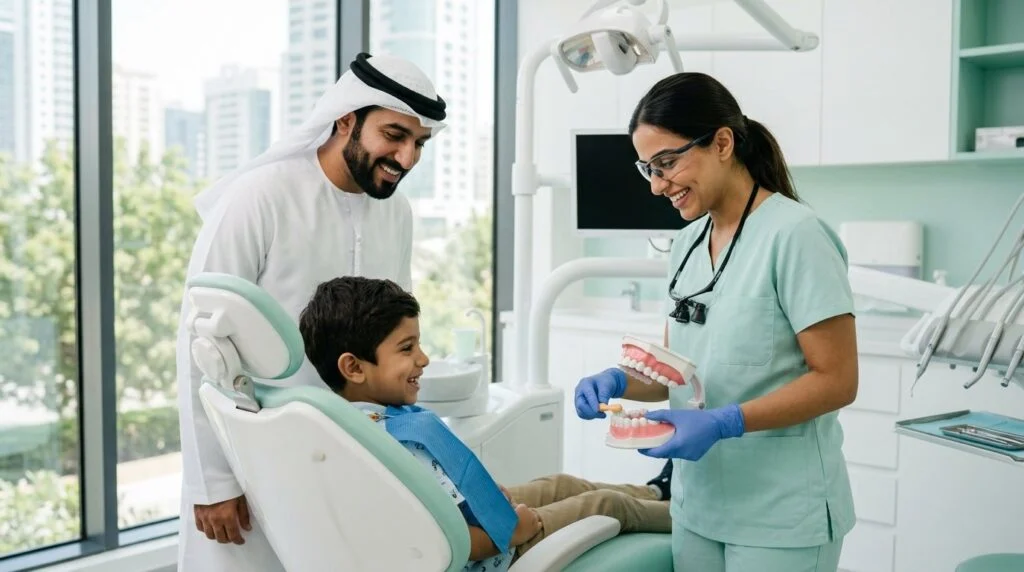
Your child’s first dental visit: a calm, happy start
A good first experience shapes how your child feels about the dentist for years. Here is when to go, what happens, and simple ways to prepare them at home.
Why the first visit matters
Children who have positive early experiences at the dentist usually grow into adults who are relaxed about check-ups, and that habit protects their teeth for life. The first dental visit is not really about treatment. It’s about meeting a friendly team, sitting in the big chair, and learning that the dentist is a normal, safe place.
This guide explains when to book your child’s first dental visit, what happens during it, how to prepare your child at home, the words to use and avoid, and what to do if your child is nervous.

When should the first dental visit be?
Book your child’s first dental visit once the first teeth appear, and no later than the first birthday. That may sound early, but a short visit at this age lets the dentist check the teeth and gums, spot early signs of decay, and give you advice on brushing, feeding, teething and fluoride. Decay can start as soon as teeth arrive, especially if a baby falls asleep with milk or juice.
If your child is older and has never been, do not worry. It is never too late, and we will go at their pace.
What happens at the first dental visit
Hello and a tour
We say hello, show the chair going up and down and let your child touch the mirror.
Count the teeth
A quick look at the teeth and gums, often with your child sitting on your lap.
Gentle clean
If your child is happy, a gentle polish and sometimes fluoride varnish.
Advice for you
Simple tips on brushing, snacks, drinks and the next visit.
How to prepare your child at home
A little preparation goes a long way. Read a picture book about visiting the dentist, or watch a short child-friendly video together. Play dentist at home: take turns counting each other’s teeth with a spoon, and let your child count a teddy’s teeth. Talk about the visit in a positive, matter-of-fact way, the same way you would talk about a trip to the park.
Choose a time when your child is well rested and fed, such as mid-morning or after school, and bring a favourite toy or comforter. Because we’re open until 10 PM seven days a week, it’s easy to find a slot that fits around naps and nursery.
Helpful ideas
- Read a picture book about the dentist
- Play dentist with a teddy
- Book a time when they are rested
- Bring a favourite toy
- Praise them afterwards
Words to use and words to avoid
Children pick up on our language and our feelings. Use simple, positive words: the dentist will count your teeth, look at your smile, and make your teeth shiny. Avoid words like hurt, pain, needle, drill or brave, which plant ideas your child may never have had. Don’t promise that nothing will hurt; simply say the dentist will be gentle and will tell them what is happening.
If you feel anxious about the dentist yourself, try not to show it in front of your child. Let the dental team explain things in their own child-friendly way.
Not sure what you need?
Get a free check-up and X-ray. A dentist explains your options and gives you the cost in writing. Open until 10 PM on Al Khan Street, Al Majaz.
If your child is nervous or upset
It is completely normal for a young child to cry or refuse to open their mouth at their first check-up. We never force anything. Sometimes the first visit is just a ride in the chair and a sticker, and that’s a success. We’ll try again another day, and most children are much more confident by the second or third visit.
Children with autism, sensory sensitivities or medical conditions are very welcome. Tell us when you book and we’ll plan a quieter time, allow extra time and adapt how we explain things.
What the dentist looks for
At the first visit to the dentist the dentist checks how many teeth have come through, whether they look healthy, how the gums look, and how the teeth and jaws are developing. They look for early white or brown spots that can be the start of decay, and for habits such as thumb sucking or dummy use that could affect the bite later. X-rays aren’t usually needed for very young children.
Keeping baby teeth healthy at home
Brush twice a day, last thing at night and one other time, using a fluoride toothpaste: a smear for children under three and a pea-sized amount from three to six. Help your child brush until they are around seven or eight. Spit, don’t rinse, after brushing so the fluoride keeps working.
How often children have sugar matters more than how much. Keep sweets, juice and sugary drinks to mealtimes, offer water and milk between meals, and never put a baby to bed with a bottle of milk or juice.
Daily habits
- Brush twice a day with fluoride
- Help until age seven or eight
- Water and milk between meals
- Sweets only at mealtimes
- No bottle in bed
Why baby teeth matter
Baby teeth help children chew, speak clearly and smile with confidence, and they hold the space for adult teeth. A decayed baby tooth can be painful, cause infection and affect the adult tooth growing underneath. Losing a baby tooth too early can let neighbouring teeth drift and cause crowding later. That is why the first check-up and regular check-ups are worth it.
How often after the first visit?
Most children need a check-up every six months. Children at higher risk of decay may need more frequent visits and extra fluoride. From around age six, fissure sealants can protect new adult back teeth, and from about age seven we keep an eye on how the bite is developing. Read more on our children’s dentistry page, and see the NHS guide to looking after your baby’s teeth for more tips.
Teething and the first dental visit
Many parents bring up teething at the first visit to the dentist. Teeth usually start to appear between six and twelve months, beginning with the lower front teeth. Teething can make gums sore and red, and babies may dribble more, chew everything and sleep less. A clean, chilled teething ring and gently rubbing the gum with a clean finger can help.
Teething doesn’t usually cause a high fever or diarrhoea. If your baby has those symptoms, check with your doctor rather than assuming it is teeth. Ask us about sugar-free teething gels and when it’s safe to use them.
Soothing ideas
- A chilled teething ring
- Rubbing the gum gently
- Sugar-free teething gel, if advised
- Extra cuddles and patience
Thumb sucking and dummies
Thumb sucking and dummies are completely normal for babies and toddlers. Most children stop on their own between two and four. If the habit continues once the adult front teeth start coming through, around age six, it can push the teeth forward and affect the bite. At the first check-up and later check-ups we look at how the teeth and jaws are developing, and we can suggest careful ways to help your child stop when the time is right.
Making the first dental visit part of family routine
Children copy what they see. If parents and older brothers or sisters have their check-ups at the same time, the youngest child sees that the dentist is just part of normal life. Booking family appointments back to back also saves time. Afterwards, do something enjoyable together, such as a walk at Al Majaz Waterfront, so the day ends on a happy note. A relaxed first visit to the dentist is the start of a healthy habit, not a one-off event.
First dental visit questions
What age is best for the first dental visit?
Can I stay with my child?
How long does the first dental visit take?
What if my child will not open their mouth?
Is the first visit covered by insurance?
Book your child’s first visit
Gentle, unhurried visits with a parent in the room. Open until 10 PM.
About this page
Written by the dental team at Al Jazeera Dental Clinic, a family clinic on Al Khan Street, Al Majaz 3, Sharjah, caring for patients since 1998, and medically reviewed by Dr Ranjeet Kumar, Medical Director (BDS, Diploma in Endodontics), October 2026. This is general information. Your dentist can tell you what applies to you.
Related articles
Home Whitening: Kits, Strips and Dentist Trays Compared
Home whitening compared: strips, LED kits, charcoal, whitening toothpaste and dentist-made trays. What works, what is risky, and how to whiten safe…
How to Floss Properly: A Step-by-Step Guide
How to floss properly, step by step: the right technique, how often, floss vs water flossers and interdental brushes, and how to floss with braces,…
Root Canal vs Extraction: Which Is Better for You?
Root canal vs extraction: comfort, cost over time, success rates, recovery and what replacing a tooth involves. An honest guide to saving or removi…