
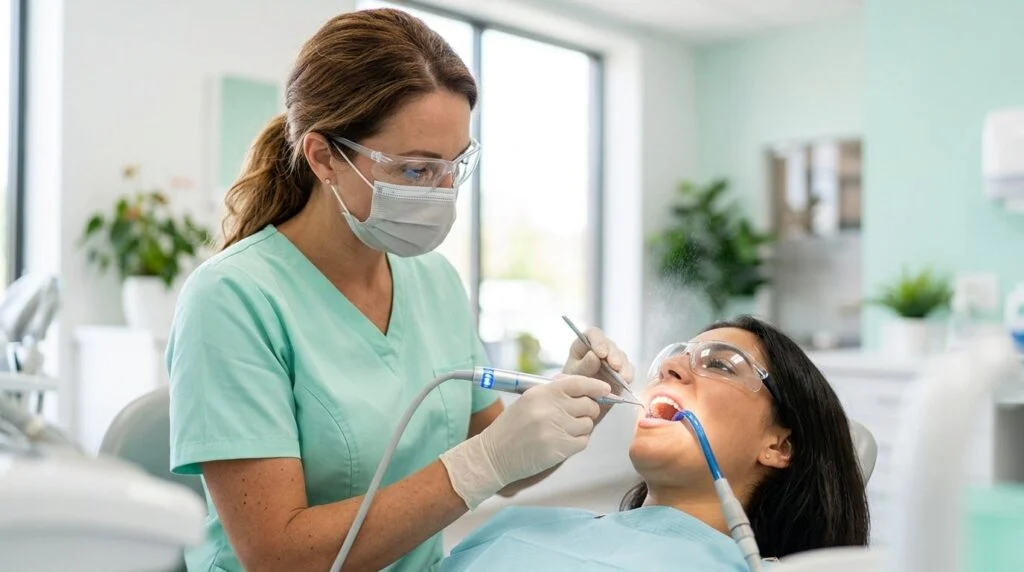
Deep cleaning cost in Sharjah: scaling and root planing explained
If you have been told you need a deep cleaning, you probably have questions about why, what it involves and what it costs. Here are clear answers.
Looking for treatment? See our main page on gum treatment in Sharjah: what is involved, who it suits, and how to book a free consultation and X-ray.
More than a polish
A routine cleaning removes plaque and tartar from the visible surfaces of the teeth and just under the gum line. A deep cleaning, known as scaling and root planing, goes further. It removes hardened tartar and bacteria from the pockets that form between the gums and teeth when gum disease takes hold.
This guide explains how to tell whether you really need a deep cleaning, what happens during treatment, what affects the cost in Sharjah, how comfortable it’s and how to keep your gums healthy afterwards.
Who needs a deep cleaning?
A deep clean is recommended when measurements show gum pockets deeper than about 4 mm, with bleeding, tartar below the gum line and sometimes bone loss on X-rays. These are signs of periodontitis, the more advanced stage of gum disease. If your gums only bleed a little and there are no deep pockets, a normal professional cleaning plus better home care is usually enough.
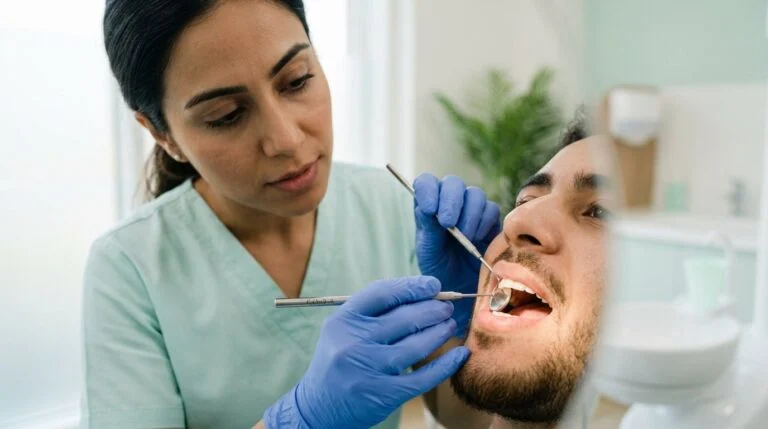
We measure the pockets around each tooth with a fine, blunt probe and show you the numbers, so you can see why a deep clean is or isn’t recommended. Read about the signs of gum disease to understand the stages.
What affects the cost of a deep cleaning
Number of areas
Treatment is often priced per quarter of the mouth. Some patients need all four areas, others only one or two.
Pocket depth
Deeper pockets take longer to clean thoroughly.
Amount of tartar
Heavy, long-standing tartar takes more time to remove.
Number of visits
Treatment may be done in one long visit or split over two.
Review appointment
A follow-up after 6 to 8 weeks checks how the gums have healed.
Insurance
Many UAE plans cover gum treatment, sometimes with prior approval.
What happens during a deep cleaning
Measuring
Pocket depths and bleeding points are recorded so we can track improvement.
Numbing
Local anaesthetic is used for the areas being treated, so you stay comfortable.
Scaling
Ultrasonic and hand instruments remove tartar and bacteria from below the gum line.
Root planing
The root surfaces are smoothed so the gum can heal and reattach more closely.
Home care plan
We show you exactly how to clean the treated areas at home.
Is it painful?
With local anaesthetic most people feel only pressure and vibration. Afterwards the gums may feel tender and teeth may be sensitive to cold for a few days to a couple of weeks as the inflammation settles. Warm salt-water rinses, a soft brush and a sensitivity toothpaste help.
After treatment
- Gums may be tender for 1 to 3 days
- Temporary cold sensitivity is common
- Bleeding should reduce within 2 weeks
- Gums may tighten and look slightly shorter
- Avoid smoking and shisha while healing
Not sure what you need?
Get a free check-up and X-ray. A dentist explains your options and gives you the cost in writing. Open until 10 PM on Al Khan Street, Al Majaz.
Results you can expect
After a deep clean, inflamed gums usually shrink and firm up, bleeding drops sharply, bad breath improves and pockets get shallower. At the review appointment we measure again. Many patients see a big improvement. Pockets that remain deep may need further treatment or a referral to a gum specialist.
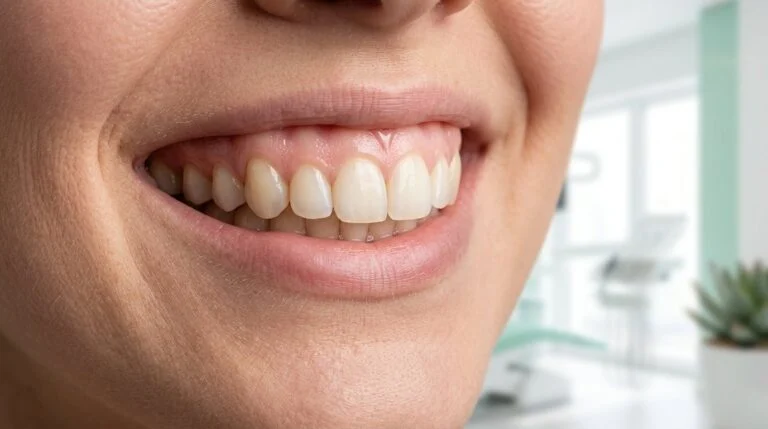
Because the gums tighten as swelling goes down, teeth can look slightly longer and small gaps may appear between them. That is a sign of healing, not damage.
Keeping your gums healthy afterwards
A deep clean removes the bacteria and tartar, but gum disease comes back if plaque builds up again. Brush twice a day for two minutes, clean between your teeth every day, and keep up regular maintenance cleanings, often every three to four months for the first year. If you smoke or use shisha, stopping makes a real difference to gum healing. People with diabetes should aim for good blood sugar control, which helps the gums too.
See our flossing guide and our page on gum treatment for more.
Deep cleaning vs regular cleaning
A regular cleaning is preventive and works on healthy or mildly inflamed gums. A deep clean is a treatment for existing gum disease and works below the gum line, usually with anaesthetic. If a clinic suggests a deep clean, it’s reasonable to ask to see your pocket measurements and X-rays. A trustworthy clinic will show you the evidence and explain why. For general information, the NHS page on gum disease is a good reference.
Why waiting costs more
Gum disease is usually painless until it’s advanced. Left untreated, it destroys the bone that holds teeth in place, and teeth can become loose. Treating gum disease early is far less involved, and far less expensive, than replacing teeth later. If your gums bleed when you brush, have them checked; read our guide to bleeding gums for what to look for.
Deep cleaning with braces, crowns and bridges
Plaque collects easily around brackets, crown edges and under bridges, so gum inflammation is common in these areas. Treatment can be done safely around braces and existing dental work. We take extra care around crown margins and show you how to use interdental brushes or super floss under bridges, so the treated areas stay healthy.
How often you will need maintenance
After treatment for gum disease, the gums need closer attention than average. Most people benefit from a maintenance cleaning every three to four months for at least the first year, then we review the interval. These visits are shorter than the first treatment and focus on keeping pockets shallow and removing any new tartar early.
Think of it like a service plan for your gums. Missing maintenance visits is the most common reason gum disease returns.
Gum disease and your general health
Research has linked gum disease with diabetes control, heart health and pregnancy outcomes. The relationship is complex, but healthy gums are clearly part of good general health. If you have diabetes, tell us at your visit; gum inflammation can make blood sugar harder to control, and better gum health may help. Pregnant women often notice more bleeding because of hormone changes, and a cleaning is safe during pregnancy.
Signs the treatment is working
Within a couple of weeks most patients notice that their gums bleed less, look pinker and feel firmer. Breath is usually fresher. At the review appointment the pocket measurements should be lower than before. If an area has not responded as well as expected, we’ll discuss further options, which may include another round of treatment in that area or referral to a gum specialist.
Book a gum assessment
If your gums bleed when you brush, a gum assessment will show whether a routine clean is enough or deep clean is needed. The consultation and X-ray are free.
Preparing for your appointment
Eat a normal meal beforehand, because your mouth may be numb for a few hours afterwards. Bring a list of your medicines, especially blood thinners, and tell us if you have diabetes, a heart condition or are pregnant. If you feel anxious, tell us when you book; we can split treatment into shorter visits and take breaks whenever you need. Plan a quiet evening afterwards with soft, lukewarm food.
A word on mouthwash
An antibacterial mouthwash may be suggested for a short time after treatment to help the gums settle. Use it exactly as advised, because some types can stain teeth if used for long periods. Mouthwash supports healing but never replaces careful brushing and cleaning between the teeth.
Deep cleaning questions
How do I know I need a deep cleaning?
Does a deep cleaning damage teeth?
How long does a deep cleaning take?
Does insurance cover a deep cleaning?
Will my gums grow back?
Bleeding or puffy gums?
Book a free gum check in Al Majaz. We will measure your gums, show you the results and give you a written plan and price.
From our team
Written by the dental team at Al Jazeera Dental Clinic, a family clinic on Al Khan Street, Al Majaz 3, Sharjah, seeing patients since 1998, and medically reviewed by Dr Ranjeet Kumar, Medical Director (BDS, Diploma in Endodontics), October 2026. General advice only. For your own teeth, book a check-up: the consultation and X-ray are free.
Related articles
Teeth Cleaning Cost in Sharjah: What a Scale and Polish Includes
Teeth cleaning price in Sharjah: what a scale and polish includes, routine vs deep cleaning, how often you need it and insurance cover. Free check-…
Root Canal Cost in Sharjah: What You Pay For
Root canal cost in Sharjah explained: front vs back teeth, number of visits, crowns, re-treatment and insurance cover. Free consultation and X-ray …
Hollywood Smile Cost in Sharjah: What Affects the Price
What really decides the Hollywood smile price in Sharjah: composite vs porcelain, how many teeth, prep work. Free mock-up consultation, written quo…