
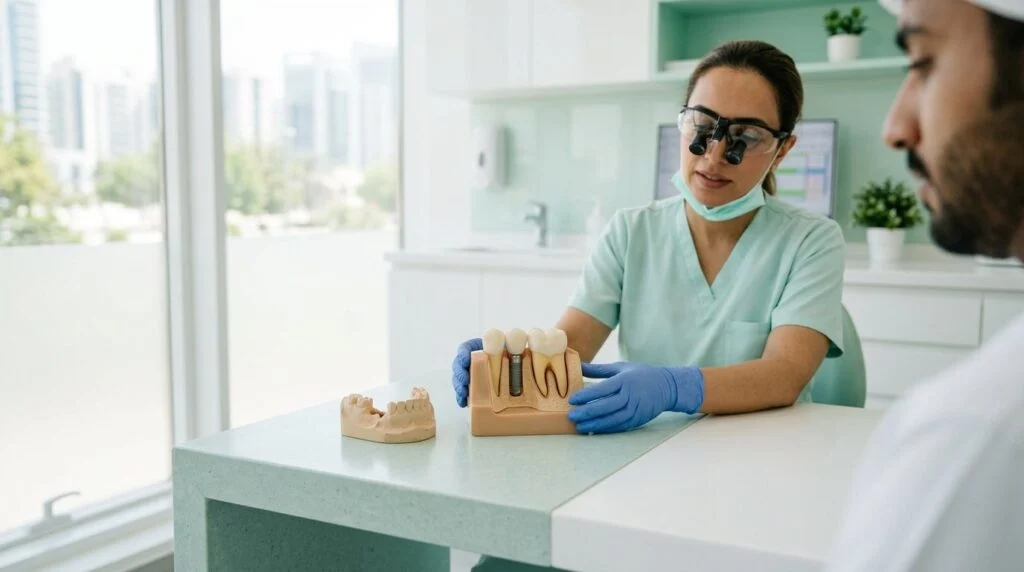
Implant vs bridge: how to replace a missing tooth
Both can restore your smile and your bite. They differ in how they are supported, how long treatment takes and what they do to the teeth around the gap. Here is an honest comparison.
Filling the gap the right way
A missing tooth is more than a gap in your smile. Over time the teeth next to it lean in, the opposite tooth drifts, and chewing becomes uneven. The two most common fixed ways to replace a tooth are a dental bridge and a dental implant, and patients often ask us to explain implant vs bridge in plain language.
This guide compares the two on eight points, explains who each suits, and covers a third option, the partial denture. At Al Jazeera Dental Clinic we make bridges and dentures in-house; when an implant is the better choice for you, we explain why and refer you to a colleague we trust, then continue to care for the rest of your mouth.
How a bridge works
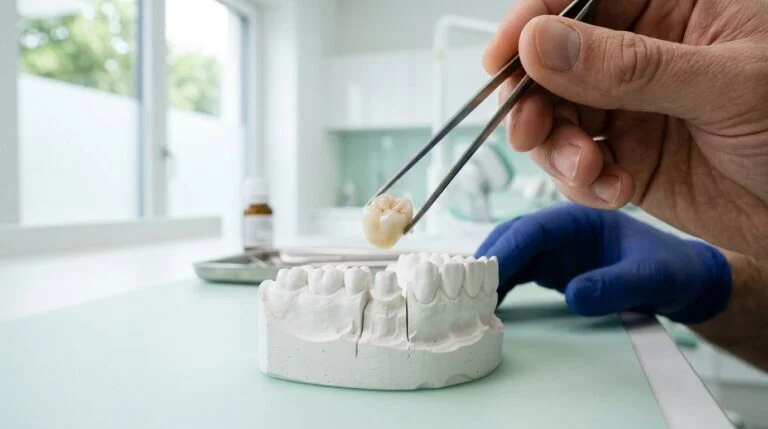
A bridge is a set of joined crowns. The teeth on either side of the gap are prepared and crowned, and a false tooth is attached between them. The bridge is cemented in place, doesn’t come out, and feels much like natural teeth. It is usually completed in two or three visits over one to three weeks.
The main drawback is that the neighbouring teeth have to be reshaped for crowns. If they are already heavily filled, that is not a disadvantage; if they are perfectly healthy, it’s a consideration in the implant vs bridge decision.
How an implant works
An implant is a small titanium post placed in the jaw bone where the root used to be. After a healing period of several months, while the bone bonds to the implant, a crown is fitted on top. The neighbouring teeth are not touched. Treatment involves a minor surgical procedure and takes longer overall than a bridge.
Implants need enough healthy bone and healthy gums, and some medical conditions and heavy smoking reduce the chance of success.
Implant vs bridge: 8 differences
1. Neighbouring teeth
Bridge: teeth either side are crowned. Implant: neighbours untouched.
2. Surgery
Bridge: none. Implant: a minor surgical procedure.
3. Treatment time
Bridge: one to three weeks. Implant: usually several months.
4. Bone
Implants help preserve the bone; under a bridge the bone slowly shrinks.
5. Cleaning
Bridges need floss threaders under the false tooth. Implants are cleaned much like a tooth.
6. Suitability
Implants need enough bone and good health. Bridges need strong neighbouring teeth.
7. Lifespan
Both can last many years with good care and check-ups.
8. Cost
A bridge usually costs less upfront; an implant often costs more initially.
When a bridge is the better choice
In our experience of the implant vs bridge choice, a bridge is often the better option when the teeth either side of the gap already have large fillings or crowns, when you want a fixed result quickly, when surgery isn’t suitable for medical reasons, or when there isn’t enough bone for an implant without grafting. In the implant vs bridge comparison, a bridge wins on speed and simplicity.
Bridge suits you if
- Neighbouring teeth already need crowns
- You want a fixed result within weeks
- Surgery isn’t advisable
- Bone is limited
Not sure what you need?
Get a free check-up and X-ray. A dentist explains your options and gives you the cost in writing. Open until 10 PM on Al Khan Street, Al Majaz.
When an implant is the better choice
Looking at implant vs bridge from the other side, an implant is often the better option when the neighbouring teeth are healthy and unfilled, when you want to preserve the jaw bone, or when a gap is at the end of a row of teeth where a bridge has nothing to anchor to. In the implant vs bridge comparison, an implant wins on protecting the surrounding teeth.
Implant suits you if
- Neighbouring teeth are healthy
- You want to preserve bone
- You’re in good general health
- You’re happy with a longer treatment time
The third option: a partial denture
A removable partial denture can replace one or several missing teeth with little or no drilling. It is the most affordable option, quick to make, and easy to add teeth to later. It comes out for cleaning and at night, which some people do not mind and others find inconvenient. It’s worth considering alongside implant vs bridge, especially when several teeth are missing in different places. See our dentures cost guide.
Cost over the years
Comparing implant vs bridge on price alone can be misleading. A bridge usually costs less on the day, while an implant costs more but doesn’t involve the neighbouring teeth. Over many years, both may need maintenance: a bridge can be lost if a supporting tooth decays, and an implant crown can need replacing. The best value is the option that suits your mouth and that you can keep clean. Read our guide to the dental crown cost in Sharjah for how bridge pricing works.
Why replace a missing tooth at all?
When a tooth is lost, the neighbouring teeth tip into the space and the opposite tooth can over-erupt, creating food traps and bite problems. Chewing shifts to the other side, which can overload those teeth. With several missing back teeth, the face can look shorter and the front teeth can spread. Whatever you decide in the implant vs bridge question, and whenever you decide it, replacing the tooth protects the rest of your mouth.
How we help you decide
Examination and X-ray
We check the gap, the neighbouring teeth, the gums and the bone.
All options explained
Bridge, partial denture or implant referral, with pros and cons for your mouth.
Written plan
You get the plan and the cost in writing for the options we provide.
Ongoing care
Whatever you choose, we look after your teeth and gums long term.
Looking after a bridge
If you choose a bridge in the implant vs bridge decision, brush twice a day with fluoride toothpaste and clean under the false tooth every day with a floss threader, superfloss or a small interdental brush. Plaque left under a bridge can cause decay in the supporting teeth and gum inflammation. Regular check-ups let us spot early problems. For independent information about bridges and implants, see the NHS guide to dental implants.
Questions to ask before choosing
Before deciding between an implant vs bridge, ask your dentist a few simple questions. The answers will show you which option really fits your mouth rather than which one sounds best in an advert. Ask about the health of the teeth either side of the gap, how much bone is available, how long each option will take, how many visits are involved, and what maintenance each needs over the next ten years.
It is also worth asking what happens if something goes wrong: if a supporting tooth decays under a bridge, or if an implant doesn’t integrate with the bone. A clear, honest answer is a good sign.
Ask about
- Health of the neighbouring teeth
- Bone available for an implant
- Number of visits and total time
- Maintenance over ten years
- What happens if a problem occurs
Front teeth and appearance
For a missing front tooth, appearance is often the deciding factor in the implant vs bridge choice. A bridge can look excellent, but the gum under the false tooth slowly shrinks over the years, which can leave a small shadow. An implant supports the gum and bone better, but needs careful planning to look natural. While an implant heals, a temporary tooth or a small partial denture keeps your smile complete. We help you plan so you’re never without a front tooth.
Gum health and smoking
Both bridges and implants need healthy gums. Gum disease around the supporting teeth can loosen a bridge, and gum disease around an implant, called peri-implantitis, can cause it to fail. Smoking and shisha reduce blood flow to the gums and slow healing, which makes problems more likely with either option. Treating gum disease and cutting down on smoking first gives any replacement tooth the best chance of lasting, whichever side of the implant vs bridge decision you choose.
Implant vs bridge questions
Which lasts longer, an implant or a bridge?
Is a bridge cheaper than an implant?
Do you place implants?
Does a bridge damage the neighbouring teeth?
Is a bridge covered by insurance?
Missing a tooth?
Free consultation to compare your options honestly.
From our team
Written by the dental team at Al Jazeera Dental Clinic, a family clinic on Al Khan Street, Al Majaz 3, Sharjah, looking after Sharjah families since 1998, and medically reviewed by Dr Ranjeet Kumar, Medical Director (BDS, Diploma in Endodontics), October 2026. General advice only. For your own teeth, book a check-up: the consultation and X-ray are free.
Related articles
Braces Cost in Sharjah: Metal, Ceramic and Aligners Compared
Compare braces costs in Sharjah: metal, ceramic and clear aligners, treatment time, retainers and insurance. Free orthodontic assessment, pay month…
Aligners vs Braces: Which Is Right for You?
Aligners vs braces compared by a Sharjah dental team: looks, comfort, results, speed, cost, cleaning and who each suits. Free orthodontic assessmen…
How Long Do Veneers Last? Porcelain vs Composite Lifespan
How long veneers last: typical lifespan of porcelain and composite veneers, what shortens it, signs they need replacing, and simple habits that hel…