
- Home
- Treatments
- Orthodontics
Orthodontics in Sharjah
Straighter teeth and a healthier bite for teenagers and adults, with metal or ceramic braces or nearly invisible clear aligners.
The straightening options we offer are retainers to hold the result.
More than a straight smile
Orthodontics is the branch of dentistry that moves teeth and guides the bite into a healthier position. Straight teeth look great, but they are also easier to clean, wear more evenly and put less strain on the jaw. Modern orthodontics is more comfortable and discreet than ever, and adults now make up a large share of patients.
This page explains who orthodontics can help, the options we offer, how treatment works, how long it takes, keeping your result and what affects the cost, at Al Jazeera Dental Clinic in Al Majaz, Sharjah.

Who can orthodontics help?
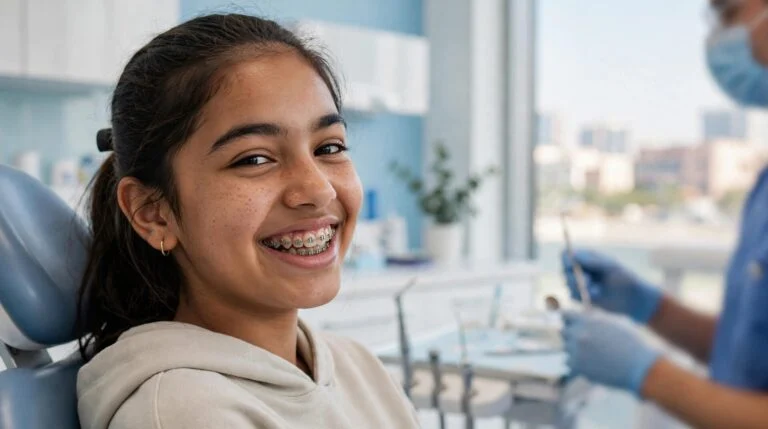
Orthodontics can treat crowded or overlapping teeth, gaps, rotated teeth, protruding front teeth and bite problems such as overbite, underbite, crossbite and open bite. It also helps adults whose teeth have moved since they had braces as a teenager.
Treatment usually starts once most adult teeth have come through, often between eleven and fourteen, but there is no upper age limit. As long as your teeth and gums are healthy, they can be moved at any age.
Common reasons for orthodontics
- Crowded or crooked teeth
- Gaps between teeth
- Overbite or underbite
- Crossbite or open bite
- Teeth that have moved after old braces
- Preparation for other dental work
Orthodontics options we offer
Metal braces
Strong, reliable and suitable for every type of case, including complex crowding and bite problems.
Ceramic braces
Tooth-coloured brackets that blend with your teeth, for a more discreet look with the same control.
Clear aligners
Nearly invisible removable trays for mild to moderate cases, worn 20 to 22 hours a day.
Braces or clear aligners?
Fixed braces work all the time and give precise control, so they are often the best choice for severe crowding, large rotations and significant bite problems. Ceramic brackets make them much less noticeable than traditional metal.
Clear aligners are removable and almost invisible, so you can eat what you like and clean normally. They suit many mild to moderate cases but rely on you wearing the trays as directed. At your free assessment we tell you honestly which approach will give you the best result.
Things that guide the choice
- Complexity of the case
- Your bite
- How visible treatment can be
- Lifestyle and discipline
- Budget
How orthodontics treatment works
We assess the bite and take an X-ray, then plan how the teeth need to move. Braces or aligners apply gentle pressure and are adjusted or changed every few weeks, with most cases running twelve to twenty-four months. Once the teeth are in position a retainer holds them, because teeth drift back without one.
Free assessment
We examine your teeth, gums and bite, take X-rays and photos and discuss your goals.
Plan and cost
You get a clear plan, an estimated timeline and the full cost in writing.
Active treatment
Braces are fitted or aligners started, with check-ups every six to eight weeks.
Retainers
When your teeth are in position, retainers hold them there for the long term.
How long does orthodontics take?
Most treatment takes between six months and two years. Small adjustments to a few front teeth can be quick, while correcting a bite usually takes longer. Your timeline depends on how far the teeth need to move, your age and, with aligners, how consistently you wear them.
Check-ups are short and are usually every six to eight weeks. We’re open until 10 PM seven days a week, so it is easy to fit visits around school and work.
Typical timelines
- Minor crowding: about 6 to 12 months
- Moderate cases: about 12 to 18 months
- Bite correction: about 18 to 24 months
Orthodontics for teenagers
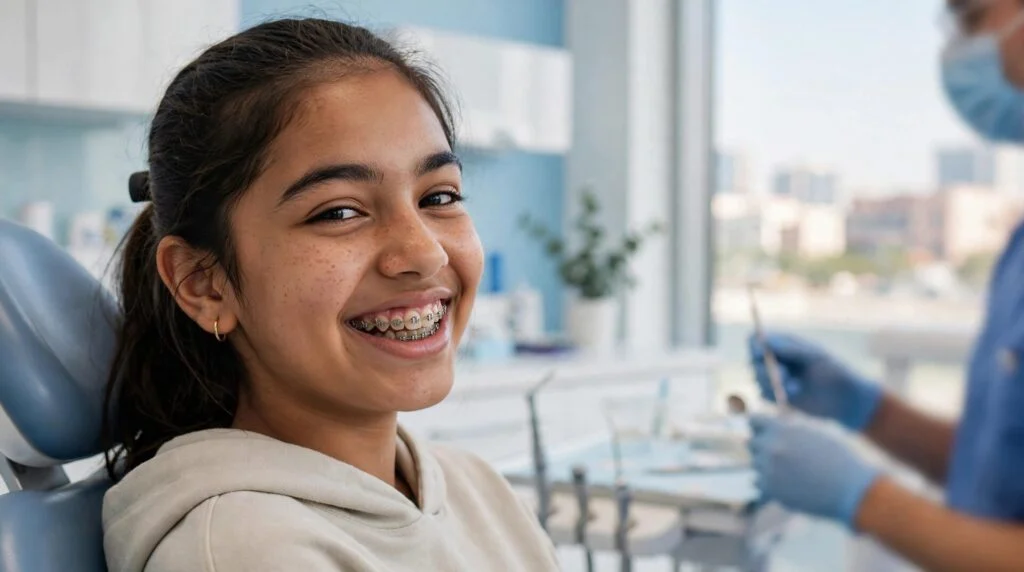
The teenage years are an ideal time for orthodontics because the jaws are still growing and teeth move readily. We explain everything to both the teen and the parents, and make sure they know how to look after their teeth and appliance.
Good cleaning is essential, as plaque around brackets can leave white marks on teeth. We show teens how to brush around brackets and recommend interdental brushes and fluoride mouthwash. Mouthguards are important for contact sports.
For parents
- First orthodontic check around age 7
- Most treatment starts age 11 to 14
- Regular cleans during treatment
- Sports mouthguard if needed
Orthodontics for adults
Many adults straighten their teeth for the first time, or after teeth have shifted since childhood. Ceramic braces and clear aligners make treatment discreet at work. Healthy gums are essential, so we check and treat any gum problems first.
Orthodontics can also make other treatment easier, for example lining teeth up before crowns or veneers, or closing gaps before replacing missing teeth.
Living with braces or aligners
Teeth feel tender for a few days after braces are fitted or adjusted, or when you start a new set of aligners. Soft food and an ordinary painkiller help. With braces, avoid hard and sticky food such as nuts, toffee and ice, and cut food into small pieces.
With aligners, take them out to eat and drink anything except water, and brush before putting them back in. Keep them in their case, never in a napkin, and clean them daily with cool water.
Daily care
- Brush after meals
- Interdental brushes around brackets
- Fluoride mouthwash
- Clean aligners daily
- Keep up regular cleans
Keeping your teeth straight
Teeth naturally try to move back after treatment, especially in the first year. Retainers hold them in place. Most people wear a clear removable retainer at night, and some also have a thin bonded wire behind the front teeth.
Retainers are part of orthodontics, not an optional extra. Wearing them as advised is the best way to protect your result for life. Replace them when they wear out or crack.
Retainer tips
- Wear exactly as advised
- Clean with cool water
- Store in the case
- Bring to check-ups
Orthodontics: myths and facts
Myth: braces are only for children
Fact: adults of any age can have treatment if their gums are healthy.
Myth: aligners suit everyone
Fact: aligners suit many cases, but some need fixed braces.
Myth: braces are very painful
Fact: teeth feel tender for a few days after adjustments, then settle.
Myth: results last without retainers
Fact: teeth move throughout life, so retainers are essential.
Eating with braces
You can still enjoy most of your favourite food during treatment with a few small changes. Cut apples, carrots and sandwiches into small pieces rather than biting into them with your front teeth. Choose soft bread, rice, pasta, fish, eggs, yoghurt and cooked vegetables in the first few days after an adjustment, when teeth feel tender.
Avoid very hard and sticky food that can break brackets or bend wires, and limit sugary snacks and fizzy drinks, which can leave white marks around brackets. If a bracket comes loose or a wire pokes, call us and we’ll fix it quickly.
Best avoided
- Nuts and hard sweets
- Toffee and chewing gum
- Ice cubes
- Popcorn
- Fizzy and sugary drinks
Healthy gums come first
Teeth move through the bone that surrounds them, so the gums and bone need to be healthy before any treatment begins. At your assessment we check your gums carefully and, if needed, arrange a professional clean or gum treatment first. During treatment we keep an eye on your gums at every visit, because brackets and trays make cleaning harder. Regular cleans every three to six months help keep everything healthy until your new smile is complete.
Before we start
- Gum check
- Clean if needed
- Fillings for any decay
- X-rays and photos
How much does orthodontics cost in Sharjah?
It depends on the type of treatment, how much the teeth need to move and how long it takes. That is why we don’t put one number on this page that could be wrong for you. Your orthodontic assessment is free and you get the full cost in writing before anything starts.
Orthodontic cover varies between insurance plans, so send us your card and we’ll check. Many patients spread the cost in monthly instalments with Tabby, Tamara or Toothpick. Insurance and payment options.
Orthodontics near you in Sharjah
- Open Sunday to Friday 9 AM to 10 PM, Saturday 12:30 PM to 10 PM
- Free consultation and X-ray
- Written cost before treatment
- Insurance: FMC, NGI, Inayah, Aafiya, SAICO / Damana, GlobeMed and MSH, plus the Fazaa and Esaad discount cards
- Pay later with Tabby, Tamara or Toothpick
We are on Al Khan Street, Al Majaz 3, a short drive from Al Qasba, Al Nahda, Al Taawun, Rolla, Abu Shagara and Buhairah Corniche, with parking in front.
Get directionsLooking for an orthodontist in Sharjah?
Many people search for an orthodontist when what they need is a clear plan for braces or aligners and someone who follows it through. At Al Jazeera Dental Clinic, orthodontic treatment is planned and followed up by Dr Anija Sreekumar, a general dentist with a Master’s Certificate in Orthodontics (MCO). The same dentist sees you from the first X-ray to your retainers.
In the UAE, “orthodontist” is a licensed specialist title. Crowding, gaps and most mild to moderate bite problems are treated every day by trained general dentists. If your X-rays show a jaw or bite problem that needs a specialist orthodontist, we will tell you at the free assessment and explain your options.
Your orthodontic dentist
- Dr Anija Sreekumar, MCO Orthodontics
- Metal and ceramic braces, clear aligners, retainers
- Teenagers and adults
- English, Hindi and Malayalam
- Free assessment and X-ray
Orthodontics questions
Is there an orthodontist at Al Jazeera Dental Clinic?
What age is best for orthodontics?
Are clear aligners as good as braces?
Do braces hurt?
How often are check-ups?
Is orthodontics covered by insurance?
780+ Google reviews · Caring for Sharjah families since 1998 · 9 insurance networks · Read our reviews on Google
Ready for straighter teeth?
Free orthodontic assessment. Pay monthly with Tabby, Tamara or Toothpick.
Related articles
Clear Aligners Cost in Sharjah: What You Are Paying For
Clear aligners cost in Sharjah explained: what affects the price, number of trays, refinements, retainers, insurance and instalments, and how to co…
Tooth Filling Cost in Sharjah: What Sets the Price
Tooth filling price in Sharjah depends on size, material and insurance. Get a free X-ray and a written price before we start. Most fillings done in…
Electric Toothbrush vs Manual: Which Cleans Better?
Electric toothbrush or manual? What the research shows, which type suits braces, gums and children, how to brush properly and when a manual brush i…