
- Home
- Treatments
- General dentistry
- Gum treatment
Gum treatment in Sharjah
Bleeding, swollen or receding gums are usually signs of gum disease. It’s common, often painless and very treatable, especially when it’s caught early.
New patients usually want to know what the first visit covers and how far the clinic is from their area.
Healthy gums keep your teeth
Gum disease is the main reason adults lose teeth, yet it rarely hurts until it’s advanced. If your gums bleed when you brush, that isn’t normal and it’s worth acting on. Gum treatment removes the bacteria and tartar causing the problem so your gums can heal and your teeth stay firm.
This guide explains the signs and stages of gum disease, how deep cleaning works, aftercare, keeping gums healthy and what affects the cost at Al Jazeera Dental Clinic in Al Majaz, Sharjah.
What is gum disease?
Gum disease is an infection of the tissues that hold your teeth in place. It starts when plaque builds up along the gum line. The bacteria in plaque irritate the gums, which become red, puffy and bleed easily. This early stage is called gingivitis and it’s completely reversible.
If plaque and tartar stay in place, the inflammation spreads below the gum. The gum starts to pull away from the tooth, forming pockets where bacteria thrive. Over time the bone supporting the teeth is lost. This is periodontitis. It is the most common cause of loose teeth in adults, and it’s often painless until late.
The good news: with the right gum treatment and good home care, gum disease can be stopped at any stage, and early gum disease can be reversed completely.
Common signs
- Gums that bleed when you brush or floss
- Red, swollen or tender gums
- Bad breath or a bad taste
- Gums pulling back so teeth look longer
- Teeth that feel loose or have moved
- Pus between the teeth and gums
What makes gum disease worse
Smoking is the biggest avoidable factor, followed by uncontrolled diabetes. Plaque hardens into tartar within about two days if it is not cleaned away, and from then only a dentist can remove it. Gum disease is usually painless until it is advanced, which is why it progresses unnoticed.
Smoking
Smoking is one of the strongest risk factors. It also hides bleeding, so gum disease can progress unnoticed.
Diabetes
Poorly controlled blood sugar makes gum disease worse, and treating the gums can help blood sugar control.
Pregnancy and hormones
Hormone changes make gums react more strongly to plaque, so bleeding is common in pregnancy.
Crowded teeth
Overlapping teeth are harder to clean, so plaque collects more easily.
Some medicines
Certain medicines cause dry mouth or gum overgrowth. Tell us what you take.
Family history
Some people are simply more prone to gum disease and need closer monitoring.
How gum treatment works
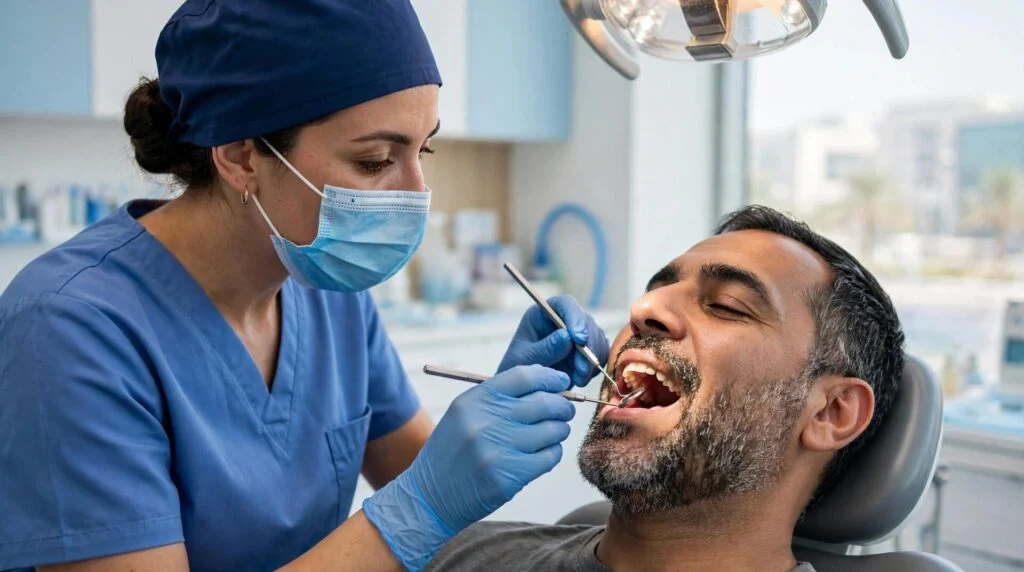
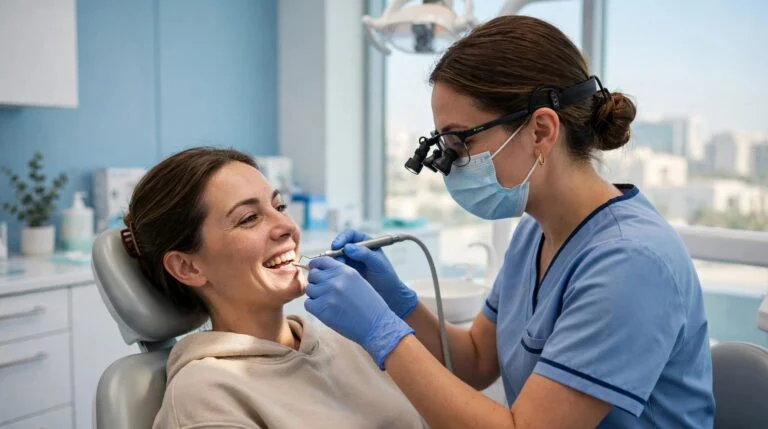
We measure the pocket around each tooth at six points, then clean below the gumline to remove the hardened deposits the gums are reacting to. Pockets of four millimetres or more are treated in sections under local anaesthetic. We re-measure afterwards to confirm the gums have tightened.
Gum check
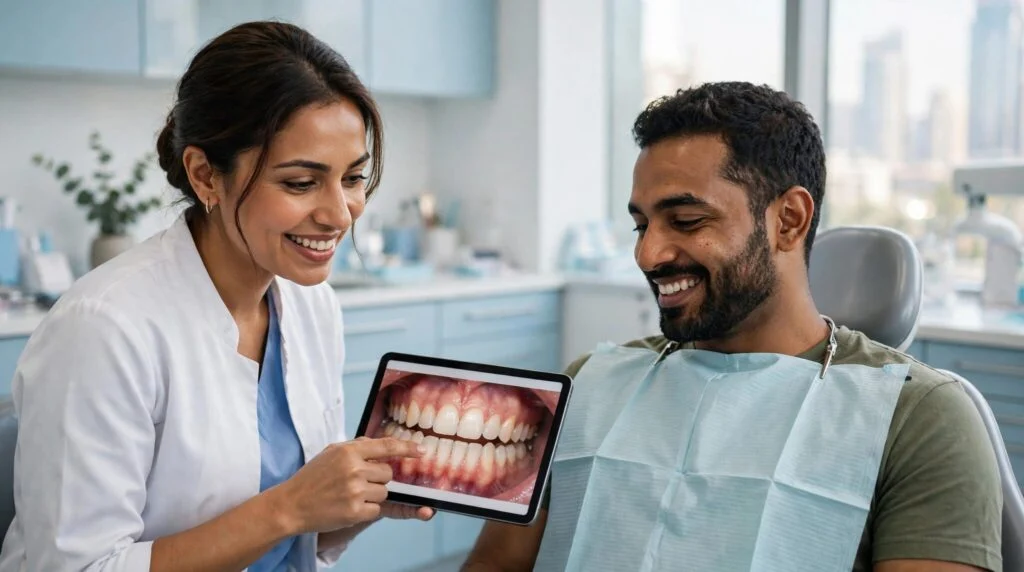
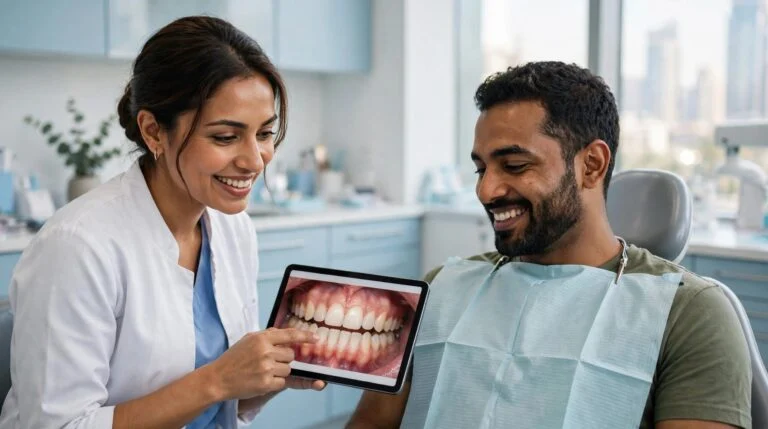
We measure the depth of the space around each tooth and take X-rays to check the bone. You see the readings.
Deep cleaning
Tartar and bacteria are removed from above and below the gum line. Deeper areas are numbed and cleaned in sections.
Home care coaching
We show you exactly where you’re missing, and the right brushes and technique for your mouth.
Review
After six to eight weeks we measure again to see how the gums have healed and plan maintenance.
Deep cleaning (scaling and root planing)
The core of gum treatment is a thorough deep clean below the gum line, known as scaling and root planing. Using ultrasonic and fine hand instruments, we remove hardened tartar and the bacterial film from the root surfaces inside the pockets, then smooth the roots so the gum can heal back against them.
Because this goes below the gum, we usually numb the area first, and we may treat the mouth in two or more sessions. Most people go back to work the same day. Gums can feel tender for a few days and teeth may be more sensitive to cold while they settle.
As the gums heal, the swelling goes down. Teeth can look slightly longer and small gaps may appear between them; this is the gum tightening back to a healthier shape.
Aftercare
- Warm salt-water rinses for a few days
- Brush gently but thoroughly, even if gums bleed at first
- Use the interdental brushes we give you every day
- A sensitivity toothpaste helps with cold sensitivity
- Avoid smoking: it slows healing
Keeping gums healthy after treatment
Gum disease can come back if plaque is allowed to build up again, so maintenance is part of the treatment. People who have had periodontitis usually need a professional clean every three to four months rather than every six, at least at first. We’ll tell you the right interval based on how your gums respond.
At home, the most important habits are brushing twice a day along the gum line and cleaning between the teeth once a day. Interdental brushes are often more effective than floss for adults with gum disease. An electric toothbrush can help. If you smoke, stopping is one of the best things you can do for your gums.
When we refer to a specialist
Most gum disease is treated successfully in the clinic. If pockets stay deep after treatment, or there is advanced bone loss, we may recommend a gum specialist for surgical treatment and will help arrange it.
The 4 stages of gum disease
1. Gingivitis
Red, puffy gums that bleed when brushed. No bone loss yet. Fully reversible with a professional clean and better home care.
2. Early periodontitis
Shallow pockets form and a little bone is lost. Gum treatment with deep cleaning usually stops it.
3. Moderate periodontitis
Deeper pockets, more bone loss and sometimes receding gums. Needs thorough periodontal treatment and closer maintenance.
4. Advanced periodontitis
Teeth become loose or drift. Treatment aims to save as many teeth as possible; some may need specialist care.
Receding gums
When gums recede, more of the tooth is exposed and teeth can look longer and feel sensitive to cold. Gum disease is a common cause, but brushing too hard, grinding, a thin natural gum type and orthodontic movement can also play a part. Lost gum does not grow back by itself, so the aim of periodontal treatment is to stop it getting worse.
We check how much the gum has receded, find the cause, and suggest the right approach: a softer brush and better technique, a night guard, treating gum disease, or covering sensitive root surfaces. Where a gum graft would help, we’ll explain the option and refer you.
Protect receding gums
- Use a soft or electric toothbrush with light pressure
- Brush in small circles, not hard side-to-side scrubbing
- Use a sensitivity toothpaste
- Wear a night guard if you grind
Gum disease and your general health
Healthy gums matter beyond the mouth. Research links gum disease with diabetes, heart disease and complications in pregnancy. Treating gum disease reduces inflammation in the body, and for people with diabetes it can help with blood sugar control. If you have a medical condition, let us know so we can plan your periodontal treatment safely.
Bleeding gums in pregnancy
Pregnancy gingivitis is common. Professional cleaning is safe during pregnancy, ideally in the second trimester, and helps keep gums healthy for you and your baby.
How much does gum treatment cost in Sharjah?
The price of periodontal treatment depends on how many areas need deep cleaning, how deep the gum pockets are, and how many visits and follow-ups you need. That is why we do not put one number on this page that could be wrong for you.
Your gum check and X-ray are free, and you get the full cost in writing before anything starts. Periodontal treatment is covered by many UAE insurance plans, and you can spread the cost in instalments with Tabby, Tamara or Toothpick. Insurance and payment options.
Gum treatment near you in Sharjah
- Open Sunday to Friday 9 AM to 10 PM, Saturday 12:30 PM to 10 PM
- Free consultation and X-ray
- Written cost before treatment
- Insurance: FMC, NGI, Inayah, Aafiya, SAICO / Damana, GlobeMed and MSH, plus the Fazaa and Esaad discount cards
- Pay later with Tabby, Tamara or Toothpick
We are on Al Khan Street, Al Majaz 3, a short drive from Al Qasba, Al Nahda, Al Taawun, Rolla, Abu Shagara and Buhairah Corniche, with parking in front.
Get directionsGum treatment questions
Is gum treatment painful?
Can gum disease be cured?
Will my loose teeth tighten?
Why do my gums bleed more after I start flossing?
How many visits does gum treatment take?
Is gum treatment covered by insurance?
780+ Google reviews · Caring for Sharjah families since 1998 · 9 insurance networks · Read our reviews on Google
Bleeding or sore gums?
Book a free gum check. The sooner gum disease is treated, the simpler it’s.
Related problems
Gum disease is the most common reason for a loose tooth in adults. See also bleeding gums and bad breath.
About this page
Written by the dental team at Al Jazeera Dental Clinic, a family clinic on Al Khan Street, Al Majaz 3, Sharjah, treating gums since 1998, and medically reviewed by Dr Ranjeet Kumar, Medical Director (BDS, Diploma in Endodontics), November 2026 (how we write and review). Gum treatment only works alongside daily cleaning at home; the appointment is half of the job.
Related articles
Tooth Abscess: Signs, Treatment and When It Is an Emergency
Tooth abscess explained: symptoms, the different types, why antibiotics alone are not enough, treatment options and when swelling is an emergency. …
Dry Socket: Symptoms, Treatment and Prevention
Dry socket explained: what it is, how to tell it apart from normal healing, how dentists treat it, and simple steps to prevent it after a tooth ext…
After Root Canal Treatment: What Is Normal and What Is Not
What to expect after root canal treatment: normal tenderness, eating, temporary fillings, crowns, warning signs and how long healing takes. Advice …