

- Home
- Dental problems
- Toothache
Toothache in Sharjah
Sharp, throbbing or dull tooth pain is a sign that something needs attention. We find the cause with a free X-ray and relieve the pain, often on the same day.
Two things worth reading next: tooth decay, which causes most toothache and coming in when the dentist makes you nervous.
Most toothache is settled with a filling or a root canal, both part of our restorative dentistry care.
Pain is a signal, not a diagnosis
A toothache can range from a mild twinge with cold drinks to a throbbing pain that keeps you awake at night. Either way, it’s your body telling you that something inside or around a tooth needs attention. Painkillers can dull it for a while, but they do not fix the cause, and most tooth pain gets worse if it’s left.
This guide explains what different kinds of pain usually mean, the 7 most common causes, quick relief you can try at home, when it is an emergency, how we treat it and how to prevent it, at Al Jazeera Dental Clinic in Al Majaz, Sharjah.
Want a quick idea of the cause? Try our free toothache checker.


What does your toothache feel like?
The type of pain gives useful clues. A short, sharp sting with cold drinks that fades within seconds often points to sensitivity or early decay. Pain that lingers for a minute or more after something hot or cold usually means the nerve inside the tooth is inflamed.
Throbbing pain that starts on its own, wakes you at night or spreads to your ear, jaw or temple suggests the nerve is badly inflamed or infected. Pain when you bite down can mean a cracked tooth, a high filling or an infection at the root tip. A dull ache with swollen, tender gum around a back tooth is often a gum infection or a wisdom tooth.
Sometimes the upper back teeth ache because of a blocked sinus, especially during a cold. If several teeth feel tender at once and your nose is blocked, mention it when you see us.
Book the same day if you have
- Throbbing pain that keeps you awake
- Pain that lasts longer than a day or two
- Swelling of the gum, face or jaw
- Pain when biting or chewing
- A bad taste or pus near a tooth
- Fever with tooth pain
What each kind of tooth pain usually means
No table replaces an examination, and two people with the same description can need very different treatment. But the kind of pain you have narrows the likely cause considerably, and it is a useful thing to know before you are seen.
| What the pain feels like | What it usually means | What it normally needs |
|---|---|---|
| A short sharp sting with something cold that fades within seconds | Sensitivity, early decay or an exposed root surface | Fluoride treatment, a filling, or treatment for gum recession |
| Pain that lingers a minute or more after something hot or cold | The nerve inside the tooth is inflamed | A filling or root canal treatment, depending on how far it has reached |
| Throbbing that begins on its own, wakes you at night or spreads to the ear or temple | The nerve is badly inflamed or infected | Root canal treatment, or extraction where the tooth cannot be saved |
| A sharp jolt when you bite down, or when you release | A cracked tooth, a filling sitting high, or infection at the root tip | Bonding, a crown, a bite adjustment or root canal treatment |
| A dull ache with swollen, tender gum around a back tooth | Gum infection, or a wisdom tooth that has only partly come through | Cleaning and gum treatment, or removal of the wisdom tooth |
| Several upper back teeth tender at once, with a blocked nose | Often sinus pressure rather than the teeth themselves | Confirming the teeth are healthy, then treating the sinus |
| Days of throbbing that suddenly stop | The nerve may have died. The infection usually remains and returns later as an abscess | Still needs assessment, and most often root canal treatment |
7 common causes of toothache
Most tooth pain comes from one of seven things: decay reaching the inner tooth, an infected nerve, an abscess, a cracked or chipped tooth, gum disease, a wisdom tooth pushing through, or a filling or crown that has come out. Each tends to produce a different kind of pain.
1. Tooth decay
Cavities let bacteria reach the inner layers of the tooth. Early decay causes sensitivity; deeper decay reaches the nerve and causes real pain.
2. Cracked or broken tooth
A crack can let hot, cold and biting pressure reach the nerve. Pain is often sharp when you bite and release.
3. Dental abscess
An infection at the root tip or in the gum causes constant, throbbing pain, swelling and sometimes a bad taste.
4. Gum disease
Infected, inflamed gums can ache and bleed. Advanced gum disease loosens teeth and can form painful gum abscesses.
5. Wisdom teeth
A partly erupted wisdom tooth traps food and bacteria under the gum flap, causing pain, swelling and difficulty opening wide.
6. Grinding and clenching
Night-time grinding overloads the teeth and jaw muscles, causing aching teeth, a sore jaw and morning headaches.
7. Exposed roots
Receding gums or worn enamel expose the softer root surface, causing sharp sensitivity to cold, sweet or acidic food.
Quick toothache relief at home
These steps can ease the pain until you can see a dentist. They don’t treat the cause, so please book an appointment even if the pain settles.
Rinse your mouth with warm salt water and gently floss around the sore tooth to remove any trapped food. Take an ordinary over-the-counter painkiller exactly as directed on the pack, and check with a pharmacist if you take other medicines or have a medical condition. Hold a cold compress against your cheek for 15 minutes at a time to reduce swelling. Keep your head raised on an extra pillow at night, and chew on the other side.
Avoid very hot, very cold and sugary food and drink, which can trigger the nerve. If a filling has fallen out, temporary filling material from a pharmacy can cover the hole for a few days.
Please don’t
- Put aspirin or tablets on the gum, which burns it
- Apply heat to a swollen face
- Take more painkiller than the pack allows
- Use leftover antibiotics
- Ignore pain that keeps coming back
When is toothache an emergency?
Call us the same day if the pain is severe, if you have swelling, or if a tooth is broken. We keep same-day slots every day and are open until 10 PM. See our emergency dentist page for more.
Go to a hospital emergency department straight away, or call 998, if swelling is spreading towards your eye or neck, if you have difficulty swallowing or breathing, or if you have a high fever with facial swelling. These can be signs of a spreading infection that needs urgent medical care.
“The patients I worry about most are the ones whose toothache went away on its own. They assume the problem solved itself. Usually the nerve has died, the infection is still there, and it comes back weeks later as a swelling, when it is harder to treat than it would have been.”
How we find and treat the cause of your toothache
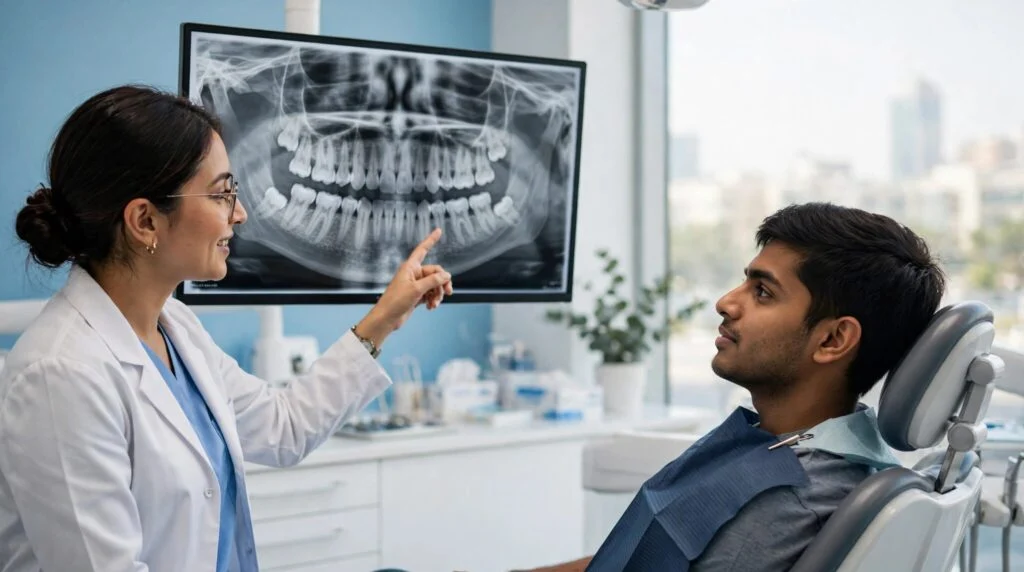
Finding the cause takes three things: what you tell us about when the pain started and what sets it off, an examination of the tooth and the gum around it, and a free X-ray showing what is happening below the surface. Treatment is only recommended once those agree.
Listen
We ask when the pain started, what triggers it and what helps, which narrows down the cause.
Examine and X-ray
We check the teeth, gums and bite, test the sore tooth and take a free X-ray to see inside.
Explain
You see the X-ray, hear what we found and get your options with the cost in writing.
Relieve the pain
Where possible we relieve the pain at the same visit, even if more treatment follows later.
Treatment depends on the cause
There is no single treatment for toothache. Shallow decay needs a filling, an infected nerve needs root canal treatment, an abscess needs the infection drained, gum problems need cleaning below the gumline, and a tooth too damaged to save needs removing. The X-ray decides which applies.
Filling
Decay that has not reached the nerve is removed and the tooth is restored with a tooth-coloured filling.
Root canal treatment
If the nerve is inflamed or infected, root canal treatment removes the pain and saves the tooth.
Extraction
If a tooth cannot be saved, or a wisdom tooth keeps causing trouble, a gentle extraction may be best.
Gum treatment
Deep cleaning and gum treatment settle infected, painful gums.
Crown or bonding
A cracked or broken tooth is protected with bonding or a dental crown.
Night guard
If grinding is the cause, a custom night guard protects your teeth while you sleep.
Why does toothache feel worse at night?
Many people notice their toothache is worst when they lie down. Lying flat increases blood flow to the head, which raises pressure around an inflamed nerve. There are also fewer distractions at night, so you notice the pain more, and some people clench their teeth in their sleep.
Raising your head with an extra pillow, taking a painkiller as directed before bed and avoiding food and drink late in the evening can help. If the pain wakes you, the nerve is often seriously inflamed and the tooth needs treatment soon.
Before bed
- Brush gently and floss around the sore tooth
- Take a painkiller as directed on the pack
- Sleep with your head raised
- Keep a cold compress ready
- Call us first thing in the morning
Toothache in children
Children often find it hard to describe a toothache. They may refuse to eat on one side, rub their cheek, become irritable or wake at night. Decay in baby teeth can progress quickly because the enamel is thinner, so it’s worth getting any complaint checked early.
Give a children’s painkiller suitable for their age and weight, and book a visit. Our children’s dentistry appointments are calm and gentle, and a parent stays in the room.
Signs in young children
- Avoiding food or chewing on one side
- Rubbing the face or ear
- Swelling or a pimple on the gum
- Waking at night upset
- A dark or discoloured tooth
How to prevent toothache
Most toothache is preventable. Brush twice a day with a fluoride toothpaste, clean between your teeth every day and cut down on how often you have sugary food and drinks. Check-ups and cleans every six months find small cavities, cracked fillings and early gum problems before they start to hurt.
If you grind your teeth, a night guard protects them. If you play contact sports, wear a mouthguard. And don’t ignore early warning signs: a tooth that’s sensitive or aches now and then is much quicker and cheaper to treat now than after it becomes painful.
Keep teeth pain-free
- Brush twice a day with fluoride
- Clean between teeth daily
- Limit sugary snacks and drinks
- Check-up and clean every six months
- Treat sensitivity early
How much does toothache treatment cost in Sharjah?
The cost depends on the cause. A small filling costs far less than root canal treatment and a crown. That is why we don’t put one number on this page that could be wrong for you. Your consultation and X-ray are free, and you get the full cost in writing before anything starts.
Most toothache treatment is covered by UAE insurance plans. We accept FMC, NGI, Inayah, Aafiya, SAICO / Damana, GlobeMed and MSH, plus the Fazaa and Esaad discount cards, and you can spread the cost with Tabby, Tamara or Toothpick. Insurance and payment options.
Toothache treatment near you in Sharjah
- Open Sunday to Friday 9 AM to 10 PM, Saturday 12:30 PM to 10 PM
- Free consultation and X-ray
- Written cost before treatment
- Insurance: FMC, NGI, Inayah, Aafiya, SAICO / Damana, GlobeMed and MSH, plus the Fazaa and Esaad discount cards
- Pay later with Tabby, Tamara or Toothpick
We’re on Al Khan Street, Al Majaz 3, a short drive from Al Qasba, Al Nahda, Al Taawun, Rolla, Abu Shagara and Buhairah Corniche, with parking in front.
Get directionsTooth pain relief at home
Home remedies can ease tooth pain for a few hours while you arrange to see a dentist. They don’t treat the cause, so the pain usually comes back. If your face is swelling, you have a fever or swallowing is difficult, get same-day care.
Pain often feels worse at night; we’re open until 10 PM every day. Arabic speakers can read مسكن ألم الأسنان.
What can help
- Over-the-counter pain relief, following the packet dose (ask a pharmacist if unsure)
- Warm salt-water rinses
- A cold compress on the cheek for 15 minutes
- A small amount of clove oil on cotton, on the tooth only
- Sleeping with your head raised
- Avoiding very hot, cold or sweet food
Toothache questions
Can toothache go away on its own?
Will antibiotics cure my toothache?
Can I be seen today?
Is the X-ray really free?
Will treatment hurt?
Can a sinus infection cause tooth pain?
Is treatment covered by insurance?
Tooth pain today?
Same-day slots every day until 10 PM. Free X-ray to find the cause.
About this page
Written by the dental team at Al Jazeera Dental Clinic, a family clinic on Al Khan Street, Al Majaz 3, Sharjah, treating toothache since 1998, and medically reviewed by Dr Ranjeet Kumar, Medical Director (BDS, Diploma in Endodontics), November 2026 (how we write and review). The patterns described here are typical, not definitive: two people with the same kind of pain can need different treatment, and only an examination and an X-ray can tell you which applies to your tooth.
Related articles
Baby Tooth Decay: Causes, Early Signs and Treatment
Baby tooth decay explained for parents: why milk teeth matter, early white spots, bottle and night feeding, treatment options for children and how …
Wisdom Tooth Pain: Causes, Relief and When to See a Dentist
Wisdom tooth pain explained: why it happens, quick relief at home, warning signs of infection, and when removal is the best option. Free X-ray at o…
مسكن ألم الأسنان: طرق تخفيف ألم الضرس في البيت ومتى تزور الطبيب
طرق آمنة لتسكين ألم الأسنان والضرس في البيت: المسكنات، الماء والملح، زيت القرنفل والكمادات الباردة، وعلامات الخطر. عيادة الجزيرة لطب الأسنان، المجا…