
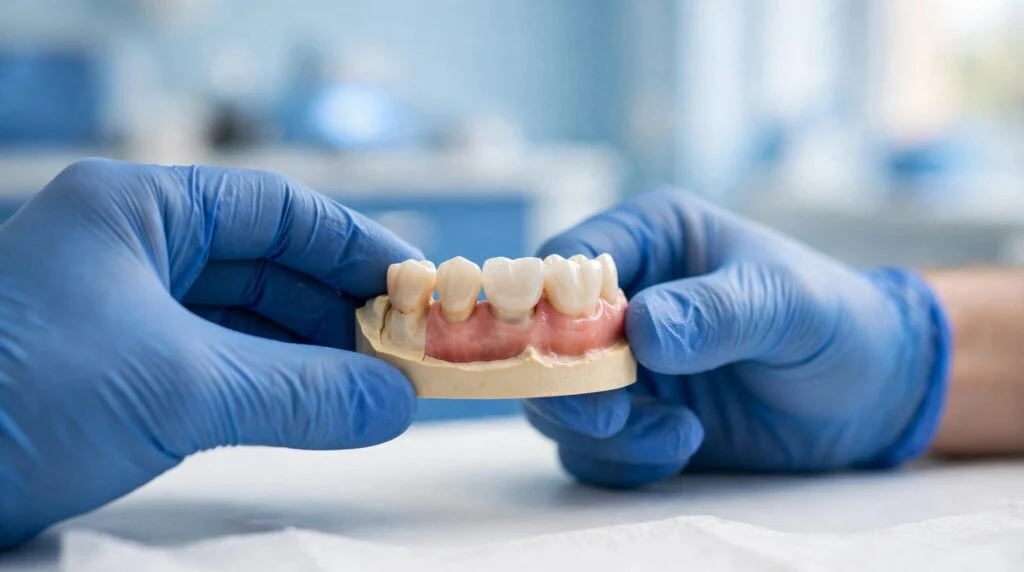
Dental bridge in Sharjah: replacing a missing tooth
A dental bridge is a fixed way to fill the gap left by a missing tooth, usually in two visits and without surgery.
Filling the gap
A missing tooth affects more than your smile. Neighbouring teeth can drift into the space, the opposite tooth can grow down, chewing becomes uneven and food traps more easily. Replacing the tooth helps protect the rest of your mouth.
A dental bridge is one of the most established ways to do that. This guide explains how a dental bridge works, the different types, who is a good candidate, how long it lasts and how it compares with implants and partial dentures, so you can choose with confidence.
Bridges sit alongside crowns and dentures in our restorative dentistry care.
How a dental bridge works
A traditional bridge uses the teeth on either side of the gap as supports. These teeth are shaped and covered with crowns, and a false tooth (called a pontic) is attached between them. The whole unit is cemented in place, so it does not come out. It looks and feels like natural teeth when you smile and chew.
Bridges are usually made from porcelain bonded to metal, all-ceramic materials or zirconia, chosen for strength and appearance depending on where the gap is.
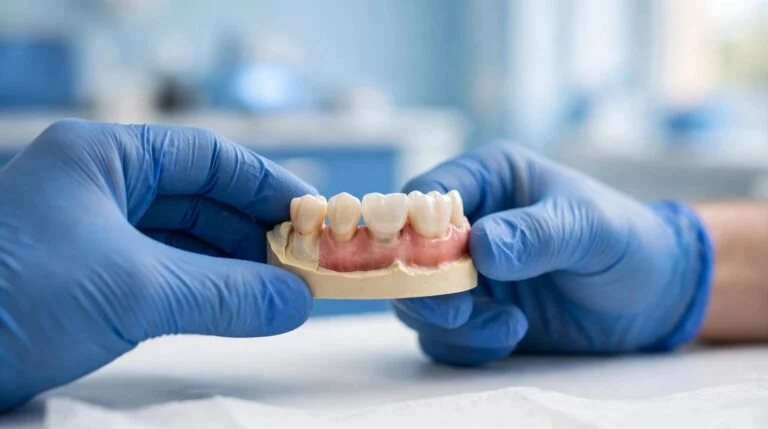

Types of dental bridge
Traditional bridge
Crowns on both neighbouring teeth hold the false tooth. The most common type.
Cantilever bridge
Supported from one side only. Used in specific situations, often at the front.
Adhesive (Maryland) bridge
A false tooth with thin wings bonded to the back of neighbouring teeth. Minimal drilling; suits some front teeth.
Implant-supported bridge
Supported by implants rather than natural teeth; placed by an implant specialist.
Who is a good candidate?
A bridge works best when the teeth next to the gap are healthy and strong enough to support it, the gums are healthy, and the gap is not too long. If the neighbouring teeth already have large fillings or crowns, a bridge can be an efficient choice, because they would benefit from crowns anyway.
Good candidates
- Healthy, strong neighbouring teeth
- Healthy gums and bone
- One or two missing teeth in a row
- Good daily cleaning habits
- A wish to avoid surgery
Getting a dental bridge
Consultation and X-ray
We check the gap, neighbouring teeth and gums. The consultation and X-ray are free.
Preparation
The supporting teeth are shaped under local anaesthetic and impressions are taken.
Temporary bridge
A temporary bridge protects the teeth while the final one is made.
Fitting
The final bridge is checked for fit, colour and bite, then cemented.
Not sure what you need?
Get a free check-up and X-ray. A dentist explains your options and gives you the cost in writing. Open until 10 PM on Al Khan Street, Al Majaz.
How long does a dental bridge last?
A well-made bridge commonly lasts 10 to 15 years or more. The main risks are decay at the edges of the supporting crowns and gum disease, both preventable with good cleaning. Grinding can also chip porcelain, so a night guard is wise for grinders. Regular check-ups and professional cleaning help a bridge last as long as possible.
Cleaning under a bridge
Food and plaque can collect under the false tooth, so cleaning there is essential. Use super floss or a floss threader to pass floss under the bridge, or small interdental brushes. A water flosser can help too. We’ll show you the best method for your bridge at the fitting appointment. Our flossing guide explains the technique.
Dental bridge vs implant vs denture
An implant replaces the tooth root and doesn’t involve the neighbouring teeth, but it needs surgery and healing time. We don’t place implants ourselves, but we refer patients to a trusted specialist when an implant suits them best. A partial denture is removable and usually the most affordable option, especially for several missing teeth. A bridge is fixed, quicker than an implant and doesn’t need surgery, but it does involve shaping the neighbouring teeth. Our guide to implant vs bridge compares the first two in detail.
Cost factors
The cost of a bridge depends on the number of units (crowns plus false teeth), the material, whether any supporting teeth need other treatment first, and your insurance. Many UAE plans cover part of the cost of bridges, sometimes after approval. See our guide to dental crown cost, since each unit of a bridge is similar to a crown, and our insurance page. For general information, see the NHS guide to bridges.
Eating and speaking with a dental bridge
Once fitted, a bridge should feel natural within a few days. Chewing is usually much easier than with a gap. Start with softer food for the first day while you get used to the bite, then eat normally. Speech is rarely affected, and if it’s, it settles quickly. If the bite feels high or uneven, come back and we will adjust it.
When a dental bridge needs replacing
Signs that a bridge may need attention include a bad taste or smell, gum swelling around the supporting teeth, sensitivity, a loose feeling or a chip in the porcelain. Book a check if you notice any of these. Sometimes only a repair is needed; sometimes the bridge needs replacing after many years of service.
Is a dental bridge right for you?
A bridge suits people with healthy teeth on either side of a gap and good gum health. We’ll check these at a free consultation and explain every option.
Front teeth and appearance
For front teeth, the colour, shape and translucency of the false tooth matter as much as strength. We match the shade carefully and shape the false tooth so it appears to emerge from the gum naturally. An adhesive bridge can be a good option for a single missing front tooth when the neighbouring teeth are unrestored, because it needs very little drilling.
What if the gap has been there for years?
If a tooth was lost long ago, neighbouring teeth may have tilted and the opposite tooth may have over-erupted. This can make replacement more complex. Sometimes a short course of orthodontic treatment straightens things first, or the opposite tooth needs adjusting. An X-ray and careful examination show what is needed before any plan is made.
Looking after the supporting teeth
The teeth holding a bridge do extra work, so keeping them healthy is vital. Fluoride toothpaste, daily cleaning under the false tooth and regular check-ups help prevent decay at the crown edges. If you grind, a night guard reduces stress on the porcelain and the supporting teeth.
Temporary options while you decide
If you need time to decide or are waiting for healing after an extraction, a temporary partial denture or temporary bridge can fill the gap so you can smile and eat comfortably. These aren’t designed for long-term use, but they help in the weeks or months before the final restoration. We’ll discuss timing so the final result is stable and comfortable.
Insurance approval tips
Many insurers require prior approval before a bridge is made. We send the X-ray and treatment plan to your insurer and let you know their answer before starting, so you know exactly what you’ll pay. Keep your Emirates ID and insurance card handy, and check whether your plan has an annual dental limit that the treatment might reach.
How many teeth can a bridge replace?
Most bridges replace one or two teeth in a row. Longer spans put more strain on the supporting teeth and aren’t always advisable. Where several teeth are missing in different areas, a partial denture or a combination of options may work better. We’ll explain what is realistic for your mouth.
Dental bridge questions
Does getting a dental bridge hurt?
How long does a dental bridge last?
Can a dental bridge be removed?
Is a bridge better than an implant?
Does insurance cover a dental bridge?
Missing a tooth?
Book a free consultation and X-ray in Al Majaz. We’ll explain whether a bridge, denture or implant suits you best and give you a written plan.
About this page
Written by the dental team at Al Jazeera Dental Clinic, a family clinic on Al Khan Street, Al Majaz 3, Sharjah, caring for patients since 1998, and medically reviewed by Dr Ranjeet Kumar, Medical Director (BDS, Diploma in Endodontics), November 2026 (how we write and review). This is general information. Your dentist can tell you what applies to you.
Related articles
Implant vs Bridge: How to Replace a Missing Tooth
Implant vs bridge explained: how each works, lifespan, cost over time, effect on neighbouring teeth, treatment time and who suits each. Honest advi…
What to Do After Tooth Extraction: Aftercare Guide
What to do after tooth extraction: stopping bleeding, pain relief, what to eat, cleaning, smoking, exercise, warning signs and replacing the tooth….
Dentures Cost in Sharjah: Full, Partial and Flexible Dentures
Dentures cost in Sharjah explained: full vs partial, acrylic vs flexible vs metal, relines and insurance. Free consultation in Al Majaz, pay in ins…